



Healthcare generates massive amounts of data every day. Medical imaging, lab reports, electronic health records, wearable monitoring devices, and genomic data streams all contribute to clinical information. Physicians must interpret these data streams quickly while maintaining accuracy and patient safety.
Artificial intelligence entered healthcare with the promise of helping clinicians process this complexity. Algorithms identify patterns in medical images, detect anomalies in vital signs, and predict patient risk scores earlier than traditional statistical tools.
Yet the conversation around AI in medicine often swings between two extremes. Some believe AI will transform healthcare entirely. Others view it as exaggerated hype.
The truth sits between these positions. AI can improve clinical decision-making when implemented correctly. But its value depends on transparency, data governance, regulatory compliance, and system integration.
Understanding the real impact of AI requires examining several structural topics in healthcare technology.
AI as Clinical Decision Support, Not Replacement
The most realistic role of AI in healthcare is clinical decision support.
AI systems analyze large datasets and identify statistical patterns that may be difficult for humans to detect quickly. Physicians then interpret those findings within the broader clinical context.
For example, sepsis prediction systems in intensive care units continuously monitor patient data such as:
- Vital signs
- Laboratory results
- Medication history
- Demographic risk factors
When the system detects patterns associated with early sepsis risk, it alerts the clinical team.
The physician evaluates the alert, reviews the patient condition, and decides whether intervention is required. AI accelerates pattern detection, but the physician remains responsible for diagnosis and treatment.
This collaborative model reflects how most successful AI deployments function today.
Explainable AI in Healthcare: Why It Matters

A major barrier to AI adoption in healthcare involves transparency.
Many machine learning systems produce predictions without clearly explaining how those predictions were generated. In medical environments, this lack of interpretability creates hesitation.
Healthcare decisions must remain traceable. Physicians must explain why a diagnosis or treatment plan was chosen.
Explainable AI, often referred to as XAI, addresses this problem.
Explainable systems highlight the variables that influenced an algorithm’s output. Instead of generating a prediction alone, the system reveals the factors that contributed to that prediction.
For example, in radiology AI:
- The model identifies a potential tumor
- The system highlights the region of the scan influencing the prediction
- The radiologist reviews both the highlight and the probability score
This transparency aligns AI output with clinical reasoning. It also supports regulatory requirements for medical software systems.
Why Healthcare Software Is Expensive and Slow to Build
Healthcare software development operates under constraints rarely seen in other industries.
Medical systems must satisfy regulatory, security, and reliability requirements before deployment. These conditions increase development complexity.
The table below summarizes the key factors influencing healthcare software development timelines.
Hospitals rely on interconnected platforms including electronic health records, laboratory systems, imaging databases, pharmacy systems, and billing systems.
Each integration introduces dependencies that must be tested carefully. Development therefore requires more time and higher investment compared with typical enterprise software.
Can Blockchain Secure Healthcare Data?

Blockchain technology frequently appears in discussions about healthcare data security.
A blockchain stores records across distributed networks. Each transaction becomes part of a cryptographically linked chain. Altering stored data becomes extremely difficult.
Supporters suggest blockchain improves healthcare data integrity and interoperability.
Several potential benefits exist:
- Immutable audit trails
- Transparent access logging
- Reduced risk of centralized data breaches
However, practical implementation challenges remain.
Medical datasets are extremely large. Imaging studies, genomic data, and longitudinal patient records require significant storage capacity. Blockchain systems struggle with this scale.
Most healthcare blockchain proposals therefore store hash references rather than full medical records.
Another limitation involves privacy regulations. Healthcare laws sometimes require modification or removal of personal data. Blockchain immutability complicates this requirement.
For these reasons, blockchain usually functions as a complementary verification layer rather than a complete healthcare database replacement.
Data Governance in Healthcare Systems

AI performance depends directly on the quality and governance of healthcare data.
Hospitals manage complex information ecosystems where multiple departments generate and access patient records. Without structured governance, inconsistencies appear across datasets.
Data governance frameworks define how organizations manage:
- Data ownership
- Data access permissions
- Data quality validation
- Privacy protection
- Regulatory compliance
Poor governance introduces bias into AI models. Inconsistent coding practices, incomplete records, and fragmented datasets reduce model reliability.
Strong governance ensures AI systems operate on accurate, well-structured data. It also protects patient privacy and maintains regulatory compliance.
How AI Improves Clinical Decision Processes
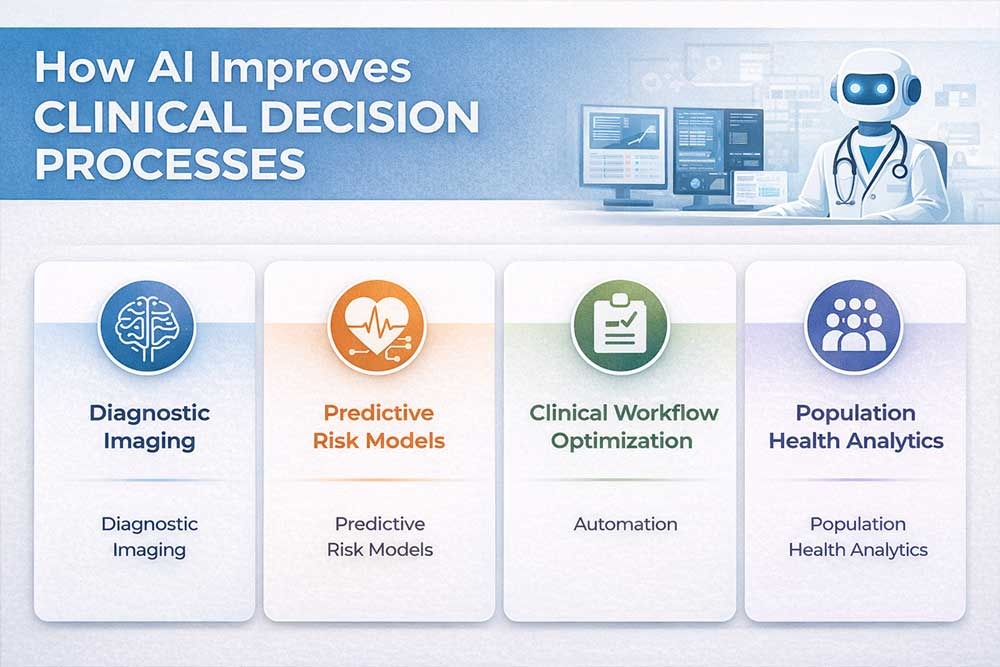
When implemented correctly, AI contributes measurable improvements in several clinical areas.
Diagnostic Imaging
Machine learning systems detect patterns in radiology scans that may indicate early disease progression.
Predictive Risk Models
AI models identify patients at risk for conditions such as sepsis, cardiac complications, or hospital readmission.
Clinical Workflow Optimization
Automation reduces administrative workload by organizing medical documentation and scheduling processes.
Population Health Analytics
Large datasets allow healthcare providers to identify public health trends and optimize treatment strategies.
These improvements occur when AI tools complement clinician expertise rather than replacing it.
The Real Limitation: System Readiness
The effectiveness of AI in healthcare depends less on algorithms and more on infrastructure readiness.
Successful deployment requires:
- Transparent algorithms
- High-quality data governance
- Secure infrastructure
- Integration with clinical workflows
- Regulatory compliance
Without these conditions, even advanced AI models struggle to deliver meaningful clinical value.
Healthcare transformation requires both technology and system maturity.
Conclusion
Artificial intelligence has already demonstrated value in several areas of medicine, particularly diagnostic imaging and predictive analytics.
Yet AI does not replace physicians. It augments their ability to analyze complex data.
Explainable AI improves transparency. Strong data governance ensures reliable datasets. Secure infrastructure protects patient information. Careful software development aligns tools with clinical workflows.
The future of AI in healthcare will depend not on hype but on responsible integration with clinical expertise.
Can AI replace doctors in clinical decision-making?
AI analyzes medical data and identifies statistical patterns. Physicians remain responsible for interpreting results, diagnosing conditions, and determining treatment.
Why is explainable AI important in healthcare?
Explainable AI reveals the factors influencing algorithm predictions. This transparency supports physician trust, regulatory compliance, and clinical accountability.
Why does healthcare software take longer to develop?
Healthcare systems require regulatory validation, strong data security, and integration with hospital infrastructure. These requirements extend development timelines.
Is blockchain suitable for healthcare records?
Blockchain can improve auditability and verification of data transactions. Most healthcare systems still store large datasets in traditional databases.
What is data governance in healthcare?
Data governance defines policies that control data quality, access rights, privacy protection, and regulatory compliance across healthcare information systems.