


Healthcare systems are under pressure. Demand is rising. Costs continue to increase. Most care still starts after symptoms appear, which leads to late intervention and higher cost.
AI changes timing and coordination. It moves decisions earlier and connects fragmented workflows.
At Innomed, the real impact is not from individual tools. It comes from integrating AI into how care is delivered across the system.
Quick Answer:
AI will shift healthcare toward early detection, automate routine care, reduce operational delays, and improve cost efficiency. It will not replace clinicians, but it will change how their time is used.
Where AI Will Change Healthcare by 2030
1. Your Health Data Will Predict Illness Before Symptoms Appear

Most healthcare systems respond after symptoms appear. This delay increases risk and cost.
AI shifts detection earlier by identifying patterns in vital signs, lab data, and clinical history. Hospitals already use early warning systems for conditions like sepsis, where early alerts improve outcomes.
By 2030, this expands into continuous risk monitoring. Data from hospital visits, outpatient care, and remote devices will combine into a single risk layer.
The main challenge is not prediction. It is signal quality. Too many alerts reduce trust and lead to ignored warnings.
Effective systems limit alerts, connect them to clear actions, and integrate into clinical workflows. When done correctly, earlier detection reduces complications and shortens hospital stays.
2. Virtual Doctors Will Handle Routine Checkups
Primary care systems handle a large number of repeat and low-complexity visits. This limits access for patients who need more attention.
AI shifts routine interactions into structured digital workflows. Patients submit symptoms, systems assess risk, and then route cases based on predefined thresholds.
Low-risk cases receive automated guidance or follow-up. Higher-risk cases are escalated to clinicians.
This reduces unnecessary visits and improves access. It also allows clinicians to focus on complex cases.
The main limitation is safety. AI must operate within strict boundaries and escalate uncertainty rather than resolve it.
When implemented correctly, virtual care becomes a filtering layer that improves system efficiency without reducing quality.
3. Drug Development Will Drop from 10 Years to 2
Drug development is slow because many candidates fail late in the process. This increases cost and delays access.
AI improves early-stage selection by analyzing biological data and molecular structures. It identifies viable candidates before they enter expensive clinical trials.
This reduces the number of failed trials and improves overall efficiency.
The timeline reduction depends on more than AI. Regulatory approval and clinical validation still require time.
The realistic outcome is not instant drug development, but fewer failures and shorter research cycles.
This shifts pharmaceutical economics by lowering the cost per successful drug and improving the speed of innovation.
4. Personalized Medicine Will Become the Norm
Most treatments are based on population averages. This limits effectiveness for individual patients.
AI enables patient-specific decisions by combining genetic data, medical history, and treatment response patterns.
This approach already exists in oncology, where treatment plans depend on genetic markers. By 2030, it expands into broader areas such as chronic disease management.
The challenge is usability. More data increases complexity for clinicians.
Systems must translate complex data into clear recommendations. Without this, decision-making becomes harder, not easier.
Trust also plays a role. Clinicians need to understand how recommendations are generated.
When implemented properly, personalized medicine improves outcomes and reduces unnecessary treatments.
5. Emergency Rooms Will Use AI to Eliminate Unnecessary Waits
Emergency departments rarely fail because of patient volume alone. Most delays come from poor coordination across triage, diagnostics, bed availability, and discharge.
AI improves how these pieces connect.
Instead of managing each step separately, AI creates a system-level view of patient flow. It predicts incoming demand, prioritizes patients based on severity, and aligns resources in real time.
For example, if inpatient beds are limited, the system can flag bottlenecks earlier and adjust triage decisions. If diagnostic queues grow, workflows can shift to reduce idle time.
This does not remove wait times entirely. Emergency demand is unpredictable.
But it reduces unnecessary delays caused by fragmentation. The result is faster movement through the system and better use of existing capacity.
6. Mental Health Support Will Be Available 24/7 Through AI
Mental health services are limited by availability. Many patients face long wait times or inconsistent follow-up.
AI expands access through continuous support systems.
These systems provide structured interaction outside clinical visits. They track mood patterns, guide users through evidence-based exercises, and monitor changes over time.
The main advantage is consistency. Support becomes available without scheduling barriers.
AI does not replace therapists. It acts as a support layer between sessions and as an entry point for patients who would not otherwise seek help.
The key requirement is risk detection. Systems must identify signs of escalation and route patients to human care immediately.
Without that, these tools lose clinical value.
7. Healthcare Will Finally Become Affordable for More People

Healthcare costs increase due to delayed care, inefficiency, and administrative overhead.
AI addresses all three.
Earlier detection reduces expensive late-stage treatment. Automation reduces administrative workload. Better coordination shortens hospital stays.
These improvements reduce overall system cost.
However, cost reduction is not automatic. Efficiency gains must translate into pricing and access improvements.
If savings remain internal to providers, affordability does not improve for patients.
The long-term impact depends on how healthcare systems adopt and distribute these efficiencies.
What Needs to Happen to Get There?
AI will not transform healthcare because models improve. It will only scale when healthcare systems change how they operate.
The gap today is not technical capability. It is operational readiness.
Infrastructure and Data Readiness
Most healthcare systems are not designed for continuous data use. Data is fragmented across departments, vendors, and formats. Even within a single hospital, clinical, administrative, and diagnostic systems often do not communicate effectively.
This limits AI performance before it even begins.
High-quality models depend on consistent, structured, and connected data. Without this, predictions become unreliable and difficult to act on.
The real requirement is not more data. It is better data flow.
Healthcare systems must move toward:
- Interoperable platforms across hospital and outpatient care
- Standardized data structures for clinical use
- Real-time access to patient data at the point of decision
Without these changes, AI remains isolated and underutilized.
Regulation and Clinical Accountability
AI introduces a new problem into healthcare decision-making. When a system contributes to a decision, responsibility becomes unclear.
Today, most regulatory frameworks evaluate tools, not workflows. AI does not operate as a static tool. It operates inside decision chains.
This creates three critical gaps:
- How models are validated in real clinical environments
- Who is accountable when AI contributes to an error
- How often systems must be re-evaluated as data changes
If these questions remain unresolved, adoption slows.
Hospitals will not integrate systems that introduce legal ambiguity into clinical workflows.
Effective regulation must move beyond approval. It must define how AI operates over time, not just at deployment.
Clinical Workflow Integration
Many AI deployments fail not because of poor models, but because they are added on top of existing workflows instead of replacing parts of them.
Clinicians do not adopt systems that increase cognitive load.
If an AI system requires additional steps, separate interfaces, or manual interpretation, it will be ignored.
Integration requires:
- Embedding AI outputs directly into existing clinical systems
- Aligning outputs with specific decision points
- Reducing, not increasing, the number of steps in a workflow
AI must remove friction. If it adds friction, it fails regardless of accuracy.
Trust Is Built Through Failure Handling
Most discussions around AI focus on performance metrics. Accuracy, precision, recall.
In clinical environments, trust is not built on average performance. It is built on how systems behave when they are wrong.
Every AI system will fail under certain conditions. The question is not whether failure happens. It is how it is managed.
Healthcare systems must define:
- When AI output should be ignored
- How clinicians are alerted to uncertainty
- How errors are tracked and corrected over time
Without clear failure handling, clinicians will not rely on AI in critical situations.
Trust does not come from performance claims. It comes from predictable behavior under uncertainty.
Economic Incentives Must Align With Outcomes
AI improves efficiency. That does not guarantee improved access or lower cost for patients.
Healthcare systems operate within financial structures that do not always reward efficiency.
If reducing hospital stays or automating processes reduces revenue, adoption slows.
For AI to scale, incentives must shift toward outcomes, not volume.
This includes:
- Payment models that reward prevention and early intervention
- Cost structures that benefit from efficiency gains
- Investment models that support long-term system improvement
Without economic alignment, AI remains a technical improvement, not a system transformation.
The Silent Pillar: Data Privacy and Cybersecurity in the AI Era
As healthcare transitions to a data-driven model, the perimeter of medical security expands. By 2030, a healthcare system’s resilience will be measured by its Data Sovereignty.
Beyond simple encryption, the future demands Federated Learning, where AI models are trained on decentralized data without ever moving sensitive patient records from their local servers.
This minimizes the risk of mass data breaches while maintaining high-speed innovation. For clinicians and patients alike, trust in AI is inseparable from the integrity of the data it consumes.
Establishing transparent Audit Trails and robust cyber-defense layers is no longer a technical choice; it is a clinical necessity to ensure that the shift toward predictive medicine does not compromise patient confidentiality.
Final Insight: What This Shift Really Means for Healthcare Systems
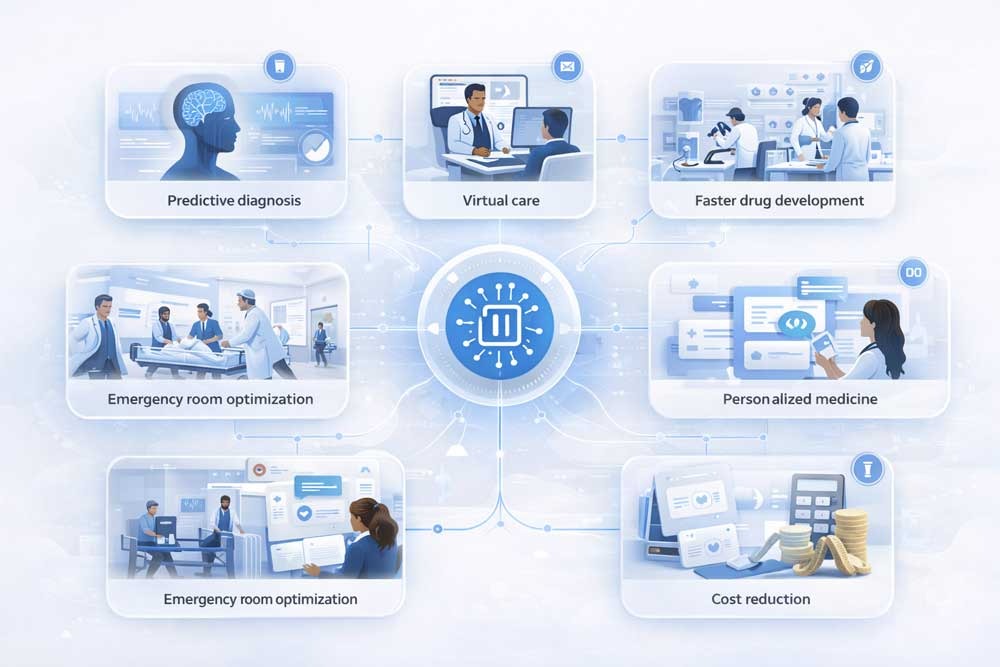
AI will not transform healthcare by being added to existing systems. It will force those systems to change.
Most organizations today are approaching AI as an upgrade. They are adding tools without redesigning workflows. This approach creates marginal improvements, not structural change.
The real shift happens when healthcare systems start removing steps, not adding them.
By 2030, the gap between leading and lagging organizations will not be defined by access to AI. It will be defined by how deeply they integrate it into decision-making and operations.
Leading systems will:
- Move from reactive care to continuous risk management
- Replace fragmented workflows with coordinated systems
- Reduce dependency on manual processes
Others will continue to operate with disconnected tools and limited impact.
This is not a technology race. It is an operational one.
At Innomed, the focus is on how healthcare systems make this transition without increasing risk, complexity, or clinician burden. The organizations that get this right will not only improve outcomes. They will define the next standard of care.
If you liked this article, you might be interested in reading this article, too:
10 Ways Hospitals Are Using AI Right Now.
Frequently Asked Questions
What is the future of AI in healthcare by 2030?
By 2030, AI will enable earlier disease detection, automate routine care, speed up drug development, personalize treatments, and improve hospital efficiency while reducing overall costs.
Will AI replace doctors by 2030?
No. AI will handle repetitive and data-driven tasks, but doctors will remain responsible for diagnosis, treatment decisions, and patient care.
How will AI improve patient care in hospitals and clinics?
AI will improve patient care by detecting diseases earlier, reducing delays, supporting clinical decisions, and enabling more personalized treatment plans.
How is AI already used in healthcare today?
AI is currently used in medical imaging, early warning systems, clinical documentation, patient triage, and hospital workflow optimization.
What are the real risks of using AI in healthcare systems?
The main risks include incorrect predictions, biased data, lack of transparency, and over-reliance on automated systems without proper human oversight.
Can AI reduce healthcare costs for patients in real situations?
AI can lower healthcare costs by improving efficiency, reducing unnecessary treatments, and automating administrative work, but affordability depends on how savings are passed to patients.