


Artificial intelligence has become one of the most talked about technologies in modern healthcare. Research papers regularly report impressive accuracy rates. Technology companies present polished demonstrations where algorithms detect disease in scans, predict patient risk, and analyze medical records with remarkable precision.
Yet many healthcare organizations report a different experience after deployment.
AI systems that perform well in demonstrations sometimes struggle once they enter real hospitals. Performance drops. Clinical staff ignore recommendations. Integration becomes complicated. What looked promising in controlled environments often proves difficult to use in daily medical practice.
This gap between AI demonstrations and real-world clinical performance is now one of the most important challenges in healthcare technology.
Stay with Innomed as we examine why medical AI often succeeds in demos but fails in real clinical environments.
Short Answer:
Medical AI performs well in demonstrations because those environments are controlled and optimized. Real healthcare environments introduce complexity that demonstrations rarely capture.
AI systems are usually developed under ideal conditions. Hospitals operate in unpredictable and complex environments.
Controlled Data Versus Real Hospital Data

Most medical AI systems train on highly curated datasets.
Researchers collect medical records or imaging data and prepare them for machine learning models. Missing values are removed. Labels are verified by specialists. Image quality is standardized.
This process improves model training.
However real hospital data rarely looks this clean.
Electronic health records contain incomplete documentation, inconsistent coding practices, and variations between departments. Imaging data comes from different machines with different calibration settings. Patient histories may include missing information or conflicting notes.
When AI systems trained on structured datasets encounter messy clinical data, prediction accuracy often declines.
This mismatch between training data and operational data remains one of the most common causes of healthcare AI failure.
Medical Imaging in Controlled Versus Clinical Conditions
Medical imaging is one of the most successful applications of artificial intelligence in healthcare. Algorithms analyze X-rays, MRIs, CT scans, and retinal images to detect patterns associated with disease.
In research settings these images are usually captured under ideal conditions. Imaging devices are carefully calibrated. Lighting and positioning are controlled. Images with artifacts or poor resolution are excluded from the training dataset.
Real hospitals work differently.
Technicians operate imaging equipment under time pressure. Devices come from different manufacturers. Patients may move during scanning. Lighting and positioning may vary depending on the clinical environment.
These factors introduce noise into the data.
Even small variations in image quality can affect how AI systems interpret patterns. A model trained on perfectly captured images may struggle with real clinical scans that contain motion blur, incomplete framing, or inconsistent contrast.
This explains why imaging algorithms that perform well in demonstrations sometimes lose accuracy in real deployments.
Workflow Integration Problems
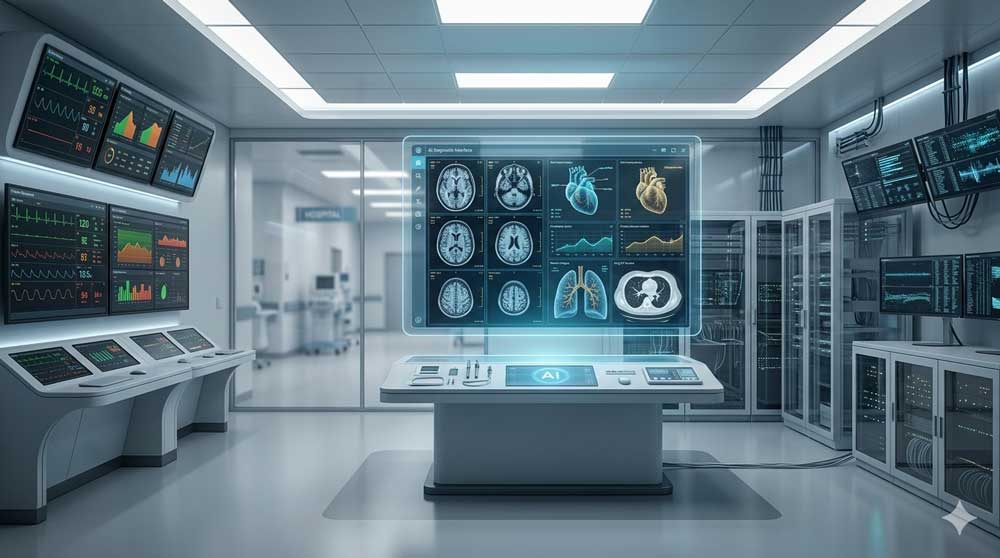
Demonstrations often focus on algorithm accuracy rather than clinical usability.
In a typical AI demo, a developer uploads a medical scan into the system. The model processes the data and produces a prediction within seconds. The result appears clean and straightforward.
Real healthcare workflows are far more complicated.
Doctors and nurses rely on multiple systems during patient care. Electronic health records store clinical notes. Imaging platforms manage diagnostic scans. Laboratory systems store test results. Hospital dashboards coordinate patient monitoring.
If an AI tool requires additional steps outside these systems, clinicians may stop using it.
Healthcare staff operate under heavy workloads. A system that slows clinical workflows or requires extra data entry quickly becomes impractical.
For AI to succeed in hospitals, it must integrate seamlessly into existing clinical systems rather than forcing clinicians to adapt to new processes.
Fragmented Healthcare Data Systems
Healthcare data rarely exists in one unified system.
Patient information may be stored across several platforms including electronic health records, laboratory databases, imaging archives, and administrative systems. These systems often use different data formats and interoperability standards.
AI developers often build models assuming access to unified datasets.
In practice hospitals operate fragmented digital environments.
Connecting AI systems to these platforms requires interoperability frameworks, secure data pipelines, and standardized data formats. Without this infrastructure, AI tools struggle to gather the information needed for accurate predictions.
Data fragmentation remains one of the largest barriers to scaling AI across healthcare organizations.
The Trust Gap Between Physicians and Algorithms

Healthcare decisions involve responsibility, accountability, and clinical judgment.
AI systems produce predictions based on patterns in data. Physicians evaluate these predictions within the context of patient history, clinical examination, and medical expertise.
In demonstrations, AI results often appear clear and convincing.
In real practice, doctors need to understand how an algorithm reached its conclusion. If a system produces recommendations without explaining the reasoning behind them, clinicians may hesitate to rely on it.
This challenge is often described as the black box problem.
Deep learning models sometimes provide highly accurate predictions while offering limited transparency into their decision processes. Without explainability, physicians may feel uncomfortable integrating these systems into clinical decision making.
Trust becomes essential for adoption.
AI tools that provide interpretable reasoning and clear supporting evidence are more likely to gain acceptance among healthcare professionals.
Demonstrations Highlight Best Case Scenarios
Technology demonstrations usually showcase ideal outcomes.
Developers select examples where the AI performs well. Demonstrations highlight clear predictions and smooth user interfaces. These scenarios help explain the potential value of the technology.
However healthcare rarely follows ideal patterns.
Patients present complex symptoms. Medical histories contain gaps. Diagnoses require balancing multiple sources of information.
When hospitals adopt AI expecting the same performance seen in demonstrations, the results may fall short.
AI performs best as a clinical support tool rather than a fully autonomous decision system. Its strength lies in assisting clinicians with pattern recognition and data analysis while physicians maintain responsibility for interpretation and treatment decisions.
Building Healthcare AI That Works in Real Life
The gap between demonstrations and real-world performance has pushed healthcare technology companies to rethink how medical AI systems are developed.
- Modern healthcare AI development increasingly focuses on several principles.
- Training datasets must represent real clinical diversity rather than idealized examples.
- AI systems must integrate directly into clinical workflows and hospital software infrastructure.
- Algorithms must provide explainable predictions that physicians can evaluate and trust.
- Healthcare organizations must invest in data interoperability so AI platforms can access reliable patient information.
These changes shift the focus from isolated algorithms toward complete healthcare technology ecosystems.
The Future of Medical AI
The next generation of healthcare AI will depend less on demonstration accuracy and more on real-world reliability.
Healthcare organizations need technology platforms that connect diagnostics, medical devices, patient data, and clinical workflows into a unified system. When these elements work together, AI systems operate with better context and produce more reliable insights.
At Innomed, our approach focuses on building this unified healthcare technology foundation. By integrating advanced diagnostics, medical device solutions, telehealth platforms, and personalized care systems, healthcare organizations move beyond isolated AI tools and toward a connected environment for data-driven medical innovation.
Organizations interested in building healthcare technology that works beyond the demo environment can explore our Healthcare Innovation Services to see how integrated platforms help transform clinical AI into real-world medical solutions.
Frequently Asked Questions
Why does medical AI perform well in demos but struggle in hospitals?
Most demos use curated datasets, controlled workflows, and standardized imaging. Real hospitals work with messy data, fragmented systems, and time-pressured environments, which reduce AI accuracy and usability.
What is the biggest reason healthcare AI fails after deployment?
The most common reason is the gap between training data and real clinical data. AI models are often trained on clean datasets that do not reflect the variability found in everyday hospital operations.
Do hospitals trust AI diagnostic systems?
Trust remains a challenge. Physicians need to understand how an algorithm reaches a conclusion. Systems that provide explainable outputs are more likely to gain acceptance among clinicians.
Is AI reliable for medical imaging analysis?
AI performs strongly in medical imaging tasks such as radiology and retinal screening. However, image quality variation, equipment differences, and patient movement can still affect performance in real clinical environments.
Will medical AI replace doctors in the future?
Current healthcare AI works best as a decision support tool. It helps clinicians analyze data and detect patterns, while physicians remain responsible for diagnosis and treatment decisions.