


Artificial intelligence has entered healthcare with remarkable speed. Hospitals now use AI tools to analyze medical images, monitor patient risks, and process large volumes of clinical data. These advances often lead to a common question: Is AI replacing doctors?
The short answer is no.
Artificial intelligence is transforming how medicine works, but it is not replacing physicians. Instead, AI functions as a decision-support technology that strengthens clinical capabilities. It processes large datasets, identifies patterns, and highlights potential risks. Physicians then interpret those insights and make the final decisions about diagnosis and treatment.
Healthcare is moving toward a model known as augmented intelligence, where medical expertise and machine analysis work together. This approach improves efficiency, reduces diagnostic oversight, and supports more informed clinical decisions across many areas of medicine.
The Real Relationship Between AI and Doctors
AI provides analytical support. Doctors provide interpretation, accountability, and care.
Why AI Often Appears More Powerful Than It Is
Public discussion around artificial intelligence in medicine often focuses on impressive demonstrations. In research environments, AI systems may detect tumors in imaging scans or predict disease risk with high statistical accuracy.
However, real healthcare environments are far more complex.
Medical data is rarely clean or complete. Patient histories may be fragmented. Electronic health records often contain inconsistencies. Diagnostic results can vary depending on equipment quality, technician expertise, and clinical context.
Artificial intelligence systems perform best with structured data. Physicians operate in environments filled with uncertainty and incomplete information.
This difference explains why AI works best as a clinical assistant rather than a replacement for doctors.
Where AI Is Already Assisting Doctors
While medical AI is hard to implement in real hospitals, artificial intelligence already supports physicians across several medical specialties. These applications focus on tasks involving large data volumes and pattern recognition.
Medical Imaging and Radiology

Radiology represents one of the most advanced applications of AI in healthcare.
Machine learning systems analyze medical images such as:
- X-rays
- CT scans
- MRI scans
- Mammography images
These systems highlight areas that may contain abnormalities. Radiologists review these findings and determine whether further investigation is necessary.
AI helps detect subtle patterns associated with early-stage disease. Early detection can significantly improve treatment outcomes for conditions such as cancer, lung disease, and neurological disorders.
Despite these capabilities, the final diagnosis still depends on a radiologist’s clinical judgment.
Pathology and Laboratory Analysis
Pathology involves examining biological samples to identify disease. AI systems assist pathologists by analyzing microscopic images of tissue samples.
Machine learning algorithms detect cellular patterns linked to cancer or other abnormalities. This process helps pathologists identify suspicious regions more quickly.
AI improves efficiency and reduces the chance of missing subtle findings. Pathologists remain responsible for confirming diagnoses and determining disease severity.
Predictive Risk Monitoring

Hospitals generate massive volumes of patient monitoring data. Artificial intelligence helps analyze these datasets to identify early warning signs of deterioration.
Predictive models assist clinicians in identifying risks such as:
- Sepsis development
- Cardiac complications
- Respiratory failure
- Hospital readmission risk
When risk levels increase, clinical teams receive alerts. Physicians evaluate the patient and decide on appropriate treatment adjustments.
This early detection approach helps prevent complications before they become life-threatening.
Clinical Decision Support
AI systems also function as advanced medical reference tools.
Clinical decision support platforms analyze patient records, symptoms, laboratory results, and imaging findings. The system then suggests possible diagnoses or treatment considerations.
Doctors evaluate these suggestions within the broader clinical context.
These systems support medical reasoning but do not replace physician judgment.
Healthcare Workflow Automation
Administrative tasks consume a significant portion of physicians’ time. Documentation, scheduling, and record management often reduce time available for patient care.
AI-driven automation helps streamline these processes by:
- Organizing patient records
- Generating structured medical documentation
- Managing appointment scheduling
- Supporting billing and coding workflows
Reducing administrative workload allows physicians to focus more on diagnosis and treatment.
Why Doctors Remain Essential in Medicine
Despite technological advances, several core aspects of healthcare still require human expertise.
Clinical Judgment and Context
Medicine rarely involves simple data interpretation. Physicians combine multiple sources of information including medical history, lifestyle factors, and patient preferences.
AI systems evaluate statistical probabilities. Physicians interpret the full context of a patient’s condition.
Ethical Responsibility
Medical decisions involve ethical and legal responsibilities. Physicians remain accountable for treatment outcomes and patient safety.
Healthcare systems require clear responsibility structures. Algorithms do not carry medical liability.
Doctors do.
Patient Communication and Trust
Healthcare involves more than diagnostics. Physicians communicate complex medical information, guide patients through treatment decisions, and provide emotional support.
Patient trust plays a major role in treatment success.
AI systems cannot replace this human interaction.
The Key Limitations of Medical AI
Although AI technologies continue improving, several challenges limit their use in healthcare.
Data Bias
Machine learning models rely on training datasets. If those datasets lack diversity, predictions may not perform equally well across different populations.
Ensuring fair and accurate AI systems requires careful dataset design and ongoing monitoring.
Regulatory Approval
Healthcare technology must pass strict regulatory review before clinical use. Medical AI systems undergo extensive validation to ensure safety and reliability.
This regulatory oversight slows deployment but protects patients.
Integration With Hospital Systems
Hospitals rely on complex digital infrastructure including electronic health records, laboratory systems, imaging platforms, and monitoring devices.
Integrating AI tools with these systems requires significant technical effort.
Many healthcare organizations spend years adapting their infrastructure before deploying AI technologies at scale.
The Real Transformation AI Brings to Healthcare

Artificial intelligence is not eliminating physicians. Instead, it is changing how healthcare teams operate.
Medicine is evolving toward a collaborative model between humans and intelligent systems.
In this model:
- AI analyzes large volumes of medical data
- Algorithms identify patterns and risks
- Physicians interpret insights and make clinical decisions
This collaboration improves diagnostic accuracy, accelerates detection of disease, and reduces administrative burden.
Healthcare systems facing physician shortages benefit particularly from these improvements.
How Hospitals Safely Implement AI
Healthcare organizations follow strict safeguards when introducing AI technologies.
These safeguards ensure that AI strengthens clinical care without replacing professional oversight.
The Future of AI in Medicine
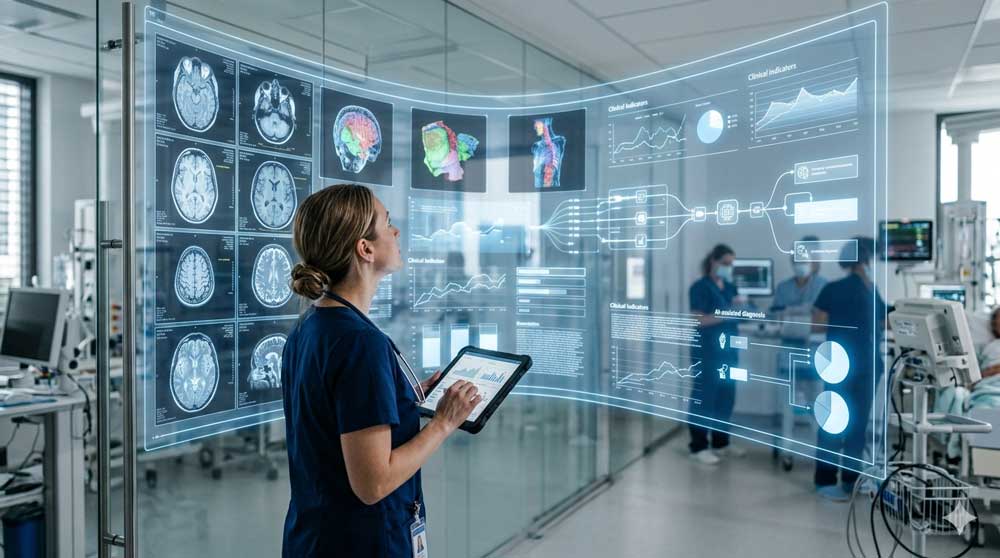
Artificial intelligence will continue expanding across healthcare in the coming years. Several developments are already shaping the next stage of medical AI.
Multimodal Diagnostics
Future AI systems will analyze multiple types of medical data simultaneously, including imaging, genetic information, laboratory results, and patient history.
Combining these datasets may improve diagnostic accuracy.
Personalized Medicine
Machine learning models are helping physicians design treatments tailored to individual patients. By analyzing genetic and lifestyle data, AI systems assist doctors in selecting therapies more likely to succeed.
Reduced Administrative Burden
Automation technologies will continue reducing the paperwork that consumes large portions of clinical time. Doctors will spend more time on patient care and less on documentation.
Final Perspective
Artificial intelligence is not replacing doctors. It is strengthening the way medicine works.
AI systems process large volumes of clinical data, identify patterns, and highlight potential risks. Physicians interpret these insights within the broader medical context and make the final decisions about diagnosis and treatment. The combination of human expertise and intelligent systems leads to faster detection, more informed clinical decisions, and improved patient outcomes.
Healthcare organizations are now focusing on how to integrate AI safely into their digital infrastructure. The real challenge is not whether artificial intelligence belongs in medicine. The challenge is building reliable, well-integrated healthcare software systems that allow clinicians to benefit from these technologies without disrupting existing workflows.
This is where thoughtful system design becomes critical. Hospitals and health technology companies need platforms that support clinical data integration, secure processing, and intelligent decision support.
If your organization is exploring how AI can enhance clinical operations, working with experienced healthcare software specialists can make a significant difference. Building the right digital infrastructure ensures that artificial intelligence supports physicians effectively and improves patient care rather than adding complexity.
Frequently Asked Questions About AI Replacing Doctors
Will AI replace radiologists?
No. AI assists radiologists by analyzing medical images and identifying possible abnormalities. Radiologists interpret these results and confirm diagnoses.
Does AI improve diagnostic accuracy?
AI systems identify patterns within large medical datasets. When combined with physician expertise, diagnostic accuracy improves.
Which medical specialties use AI the most?
Radiology, pathology, cardiology, intensive care medicine, and population health analytics currently use AI most actively.
Do hospitals rely entirely on AI systems?
No. Doctors review all AI-generated insights before making treatment decisions.
Is AI safe in healthcare?
Medical AI systems undergo strict regulatory review and clinical validation before hospitals deploy them. Continuous monitoring ensures patient safety.