



Emergency care feels unpredictable for most people. You do not know how long you will wait. You do not know which hospital is less crowded. In many cases, you make a decision under pressure with limited information.
At Innomed, we built WaitlessER to change that moment. The goal is simple. Give patients visibility before they walk into the system.
Short Answer:
WaitlessER is a mobile app that shows real-time emergency room wait times, nearby clinics, and estimated delays using live hospital data and AI-driven predictions. It helps you choose where to go based on actual system conditions, not guesswork.
What Is WaitlessER?
WaitlessER is a patient-facing application that provides real-time insight into emergency department activity. Instead of relying on assumptions, you see current wait conditions across multiple facilities in your area.
The platform connects live operational data with predictive modeling. It translates complex hospital workflows into simple, readable information that patients can use immediately.
The Problem It Solves
Emergency departments are designed to prioritize urgency, not arrival order. This makes the experience unpredictable for patients who are not in critical condition. Two people arriving minutes apart may face very different wait times depending on what happens inside the department.
Most patients respond to this uncertainty in the same way. They choose the closest hospital or the one they already know. This creates uneven demand across facilities. Some emergency rooms become overloaded while others operate below capacity.
The lack of visibility leads to a set of predictable problems:
- Patients choose the nearest hospital instead of the fastest one
- Non-emergency cases increase pressure on ERs
- Waiting times become uneven across facilities
- Patients experience long delays without knowing alternatives
- Healthcare resources are used inefficiently
WaitlessER addresses this gap by exposing real-time system conditions before a decision is made.
Who It's Built For
WaitlessER is designed for patients and families navigating urgent care decisions. It is especially useful in situations where care is needed quickly but is not life-threatening.
Parents deciding where to take a child with a high fever often face uncertainty about wait times. Adults dealing with injuries such as sprains or minor fractures need timely care but do not always require emergency-level resources. Elderly patients and their caregivers often need predictable access to care without extended waiting periods.
WaitlessER supports these scenarios by giving clear, actionable information at the moment of decision.
How WaitlessER Shows Real-Time ER Data

The reliability of WaitlessER depends on how it collects, updates, and interprets data from healthcare systems.
Where the Data Comes From
WaitlessER integrates with hospital systems and regional healthcare data sources. These include patient intake systems, triage queues, and internal tracking of patient flow within emergency departments.
Each hospital generates continuous data as patients move through different stages of care. WaitlessER aggregates this data and standardizes it into a consistent format that can be compared across facilities.
Historical data also plays a role. Patterns from previous days, weeks, and seasons help the system understand how demand typically evolves under similar conditions.
How Often Wait Times Update
Emergency departments are dynamic environments. Conditions change minute by minute. A sudden influx of patients or a critical case can shift wait times quickly.
WaitlessER reflects this reality by updating data continuously. The system refreshes wait time estimates at short intervals, ensuring that users see current conditions rather than outdated averages.
This constant update cycle is critical. Static estimates would not capture real-world variability. Real-time updates allow the platform to remain relevant at the moment of decision.
Understanding Wait Estimates vs Guarantees
WaitlessER provides estimates, not fixed wait times. This distinction is essential.
Emergency departments prioritize patients based on severity. A critical case arriving after you will be treated first. This is how emergency care systems are designed to function.
WaitlessER accounts for this by presenting wait times as ranges informed by real data and predictive modeling. The estimates reflect current demand and expected flow, but they cannot eliminate uncertainty entirely.
The value of the platform lies in comparison. Even with variability, the difference between facilities remains meaningful. A hospital with a two-hour estimated wait is likely still faster than one showing five hours, even if both fluctuate slightly.
Step-by-Step: Using WaitlessER to Find an ER

Patient deciding which emergency room to visit using a mobile phone before arrival
WaitlessER is designed to reduce friction. The process from opening the app to choosing a facility is straightforward.
Open the App or Website
You start by accessing WaitlessER on your phone or browser. The platform uses your location to identify nearby emergency departments and clinics.
This initial step removes the need to manually search for hospitals or compare options across multiple sources.
View Nearby ERs and Clinics on the Map
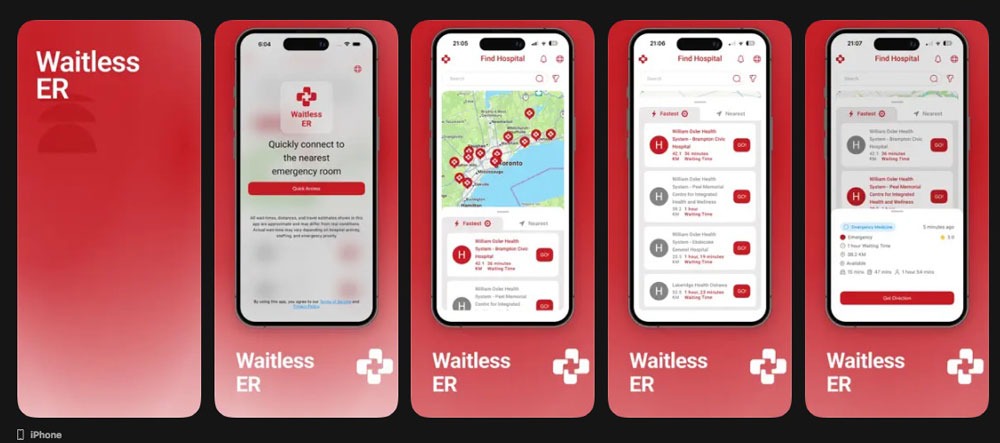
The interface presents a map-based view of available care options. Each location includes key information such as estimated wait time, distance, and type of facility.
This visual structure allows you to understand the landscape quickly. You see where congestion exists and where capacity is available.
Compare Wait Times and Choose the Best Option
The decision process shifts from assumption to comparison. Instead of defaulting to proximity, you evaluate both travel time and expected wait time.
In many cases, a slightly longer drive leads to significantly faster care. This trade-off becomes visible immediately.
The platform does not tell you what to choose. It gives you the information needed to make a better decision.
Get Directions and Go
Once you select a facility, WaitlessER provides navigation support. You move directly from evaluation to action without switching tools or repeating the search process.
This continuity matters in urgent situations. It reduces delay and keeps the focus on getting care.
Features That Make WaitlessER Different
WaitlessER is not a directory of hospitals. It is a system designed to interpret and present real-time healthcare dynamics. It stands out because it combines multiple capabilities in one system:
- AI-driven wait time predictions based on real patterns
- Integration of walk-in clinics alongside emergency rooms
- Real-time updates instead of static averages
- Seasonal demand awareness for better accuracy
- Map-based interface for faster decision-making
AI-Powered Predictions
Raw data alone does not capture the full picture of emergency department activity. WaitlessER applies AI models to identify patterns and adjust predictions based on context.
These models analyze factors such as time of day, historical congestion patterns, and current patient flow. The result is a more accurate estimate than simple averages.
This predictive layer becomes especially valuable during peak periods when conditions change rapidly.
Walk-In Clinic Integration
Not every medical situation requires emergency care. Many patients visit ERs for conditions that can be treated in walk-in clinics.
WaitlessER includes nearby clinics in its results. This allows patients to evaluate alternative options that may offer shorter wait times and appropriate care levels.
This feature benefits both patients and the healthcare system. Patients receive faster service, and emergency departments reduce unnecessary load.
Seasonal Surge Awareness
Healthcare demand is not constant throughout the year. Flu season, respiratory illness spikes, and public health events create predictable surges.
WaitlessER incorporates seasonal awareness into its predictions. It adjusts expectations based on known patterns, improving the reliability of wait time estimates during high-demand periods.
This context helps users avoid peak congestion windows when possible.
Why Real-Time ER Visibility Matters
Emergency departments operate as complex systems with limited resources. Small inefficiencies can scale quickly into major delays.
When patients lack visibility, they cluster around familiar hospitals. This creates an uneven distribution of demand. Some facilities become overwhelmed while others remain underutilized.
Real-time visibility changes this behavior. Patients spread more evenly across available facilities. Wait times decrease across the system. Access to care improves without adding new infrastructure.
WaitlessER supports this shift by turning operational data into actionable information for patients.
The Role of Patient Choice in Healthcare Flow
Healthcare systems often focus on internal optimization. Staffing, scheduling, and resource allocation are critical, but patient behavior remains a major variable.
When patients choose facilities without information, their decisions unintentionally contribute to congestion.
When patients have access to real-time data, their choices become more aligned with system capacity. This creates a feedback loop where demand distributes more efficiently.
WaitlessER introduces this layer of informed choice. It does not change how hospitals operate. It changes how patients interact with the system.
WaitlessER in the Canadian Context
Canada’s healthcare system faces consistent pressure from high demand and limited capacity in certain regions. Emergency departments often serve as the default entry point for care, even when alternatives exist.
WaitlessER is being deployed across Canadian cities to address these structural challenges. By improving visibility, it helps reduce unnecessary ER visits and encourages use of appropriate care pathways.
Regional coverage depends on data integration with local healthcare providers. As more systems connect, the platform becomes more comprehensive and more effective.
This expansion aligns with broader healthcare goals. Improve access, reduce congestion, and make better use of existing resources.
Common Use Cases
WaitlessER is most valuable in situations where timing matters but immediate emergency intervention is not required.
Patients with moderate symptoms often need care within hours, not minutes. These cases benefit from choosing the fastest available option rather than the closest one.
The platform is also useful for families managing care for dependents. It reduces uncertainty and helps avoid long, unnecessary waiting periods.
Limitations You Should Understand
No system can fully predict emergency department behavior.
WaitlessER depends on participating hospitals and available data feeds. Coverage may vary by region. Wait times can still change rapidly due to unexpected events.
The platform is designed to improve decision-making, not eliminate uncertainty. It should be used as a guide, not a guarantee.
How WaitlessER Fits Into Innomed’s Approach

At Innomed, we focus on practical improvements in healthcare access and efficiency. WaitlessER reflects this approach.
It uses real operational data. It simplifies complex systems into usable insights. It supports both patients and providers without adding friction.
The goal is not to replace existing systems. The goal is to make them easier to navigate.
Conclusion
Emergency care does not start when you walk into a hospital. It starts when you decide where to go. That decision shapes your wait time, your experience, and in many cases how quickly you receive care.
WaitlessER changes that moment. Instead of relying on habit or proximity, you act on real information. You see which emergency departments are under pressure. You identify where capacity exists. You understand whether a walk-in clinic is the better option.
At Innomed, this is the focus. Turn hidden system data into something you can use. Reduce uncertainty. Improve how patients move through care.
When more patients make informed decisions, the impact extends beyond individual cases. Wait times become more balanced. Overcrowding reduces. Access improves across the system.
This is not a feature. It is a shift in how emergency care is accessed.
Before your next urgent care visit, use WaitlessER.
Check real-time wait times. Compare nearby options. Choose based on data, not guesswork.
If you are a healthcare provider or system leader, explore how WaitlessER and our other solutions can improve patient flow and reduce pressure on your emergency departments.
Frequently Asked Questions About WaitlessER App
Is WaitlessER free to use?
Yes. Patients can use WaitlessER at no cost to check ER and clinic wait times.
How accurate are WaitlessER's wait time estimates?
Estimates are based on real-time data and predictive models. They reflect current conditions but may change as new patients arrive.
Does WaitlessER work across Canada?
The platform is expanding across Canadian cities. Availability depends on regional coverage.
Can I use WaitlessER for non-emergency visits?
Yes. The app includes walk-in clinics for non-emergency care options.
Should I rely on WaitlessER during a serious emergency?
No. In critical situations, you should go to the nearest emergency department or call emergency services immediately.