



A system raises a flag in the middle of the night.
The number is high. The risk feels urgent.
But the reasoning is silent.
In healthcare, silence is where doubt begins.
So, why is explainability so important in clinical AI?
Because without explainability, AI cannot be trusted, audited, or reliably used in real clinical workflows. And if it is not used, even the most accurate model has no clinical value.
Where Explainability Creates Real Value in Clinical AI
The Real Barrier: Misalignment with Clinical Responsibility

Healthcare organisations are not short on AI tools. What they often lack are systems that fit naturally into clinical responsibility structures.
Every decision made in a hospital must be defensible. That expectation does not disappear when AI is introduced. Instead, it becomes more complex. When a system produces a recommendation without context, it forces clinicians into a difficult position where they must either trust blindly or ignore the output entirely.
This is where many clinical AI solutions struggle in practice. They generate predictions, but they do not communicate reasoning. As a result, they remain technically impressive but operationally disconnected.
Explainability resolves this by aligning machine output with human judgement. It allows clinicians to evaluate whether a model’s reasoning reflects real clinical patterns, rather than abstract statistical correlations.
Explainability as a Driver of Trustworthy AI in Healthcare
Trust in healthcare systems is not built through claims. It is built through repeated, consistent interactions.
An explainable AI system provides visibility into how decisions are formed. It shows which variables influenced a prediction, how strongly they contributed, and whether the result aligns with known medical logic.
This is the foundation of trustworthy AI in healthcare. Without it, even advanced systems struggle to gain traction. With it, adoption becomes a natural extension of usability.
From a B2B perspective, this has direct commercial implications. Hospitals do not measure success based on theoretical performance. They measure it based on how often clinicians rely on the system in real scenarios.
Practical Scenario: From Alert to Actionable Insight
Consider a hospital implementing predictive analytics to detect early signs of patient deterioration.
In one scenario, the system produces a high-risk alert with no explanation. The clinician must pause, review patient history, interpret vital trends, and reanalyse lab results. The system has not reduced effort. It has duplicated it.
In another scenario, the alert includes a structured explanation. It highlights a sharp increase in respiratory rate, a steady drop in blood pressure, and abnormal lab indicators. It also references similar historical patterns.
The clinician immediately understands the context. The time between detection and action is reduced. The AI system becomes a support mechanism rather than an additional task.
Explainability and Clinical Workflow Efficiency
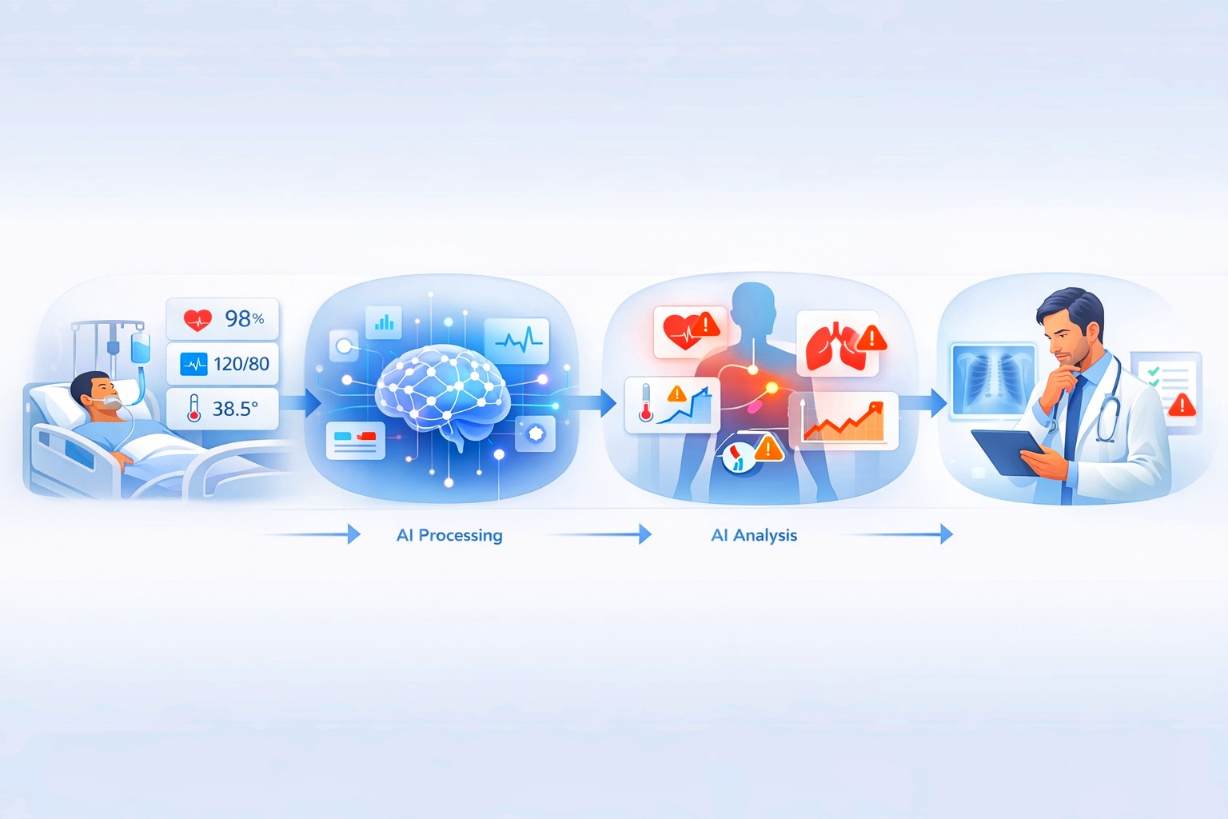
In a clinical workflow, explainable AI improves efficiency across every stage:
Alert Generation
Traditional AI provides a single risk score that requires interpretation.
Explainable AI adds contributing factors (e.g., vital sign changes, lab abnormalities), enabling faster clinical understanding.
Clinical Review
Traditional AI forces clinicians to manually reassess patient data and reconstruct reasoning.
Explainable AI highlights key variables and patterns, supporting guided validation and reducing cognitive load.
Decision Execution
Traditional AI outputs often lead to hesitation and delayed action due to lack of context.
Explainable AI enables faster, more confident decisions by making reasoning transparent.
Documentation
Traditional AI requires manual reconstruction of decision logic for compliance.
Explainable AI automatically embeds reasoning, improving traceability and reducing administrative workload.
Regulatory Pressure Is Quietly Reshaping Expectations
Healthcare AI is moving toward a model where every decision must be traceable.
Across Canada and North America, regulatory frameworks are increasingly focused on accountability. Hospitals are expected to understand not only what a system outputs, but how it arrives at that output.
Explainability supports this requirement by creating a transparent audit trail. This becomes particularly important during internal reviews, quality assurance processes, and external evaluations.
For hospital leaders, this reduces uncertainty. For technology partners, it strengthens positioning. Systems that can explain their decisions are easier to approve, easier to justify, and easier to scale across departments.
The Myth of Accuracy vs Explainability

There is a persistent assumption that more complex models automatically deliver better results. In practice, complexity without clarity often leads to underuse.
A model that clinicians understand and trust will be used more frequently than one that remains opaque, even if the latter performs slightly better in controlled testing.
This shifts how hospitals should evaluate AI solutions.
This reframing is critical for B2B decision-makers. The goal is not just to deploy AI, but to ensure it becomes part of everyday clinical decision-making.
Designing Explainability into Clinical AI Products
Explainability is most effective when it is embedded across the entire system.
At the model level, transparency techniques reveal how predictions are formed. At the interface level, these insights are translated into language that clinicians can quickly interpret. At the workflow level, explanations are delivered at the exact moment they are needed, without disrupting existing processes.
For hospitals and independent healthcare providers, this means selecting partners who treat explainability as a core design principle rather than an optional enhancement.
Long-Term Adoption Depends on Repeated Clarity
Clinical AI adoption is not immediate. It develops through repeated exposure.
Early interactions are cautious. Over time, patterns either reinforce trust or create doubt. Explainability accelerates this progression by ensuring that each interaction provides clarity rather than confusion.
Systems that consistently explain themselves become embedded in workflows. Those that do not remain secondary tools, regardless of their technical sophistication.
Final Thought: From Output to Understanding
Clinical AI does not fall short because it lacks intelligence. It falls short when it lacks clarity.
Explainability transforms AI from a passive output generator into an active participant in clinical decision-making. It connects prediction with reasoning, and reasoning with action.
For hospitals and independent providers, this is not simply a feature. It is the difference between adopting AI and actually using it.
If you are exploring how explainable AI can fit into your organisation, it may be worth taking a closer look at how Innomed approaches transparency, workflow integration, and clinical usability in its solutions.
Frequently Asked Questions (FAQ)
What is explainability in clinical AI?
Explainability refers to the ability of an AI system to clearly communicate how it arrived at a prediction or recommendation, including the key data points and reasoning involved.
Why is explainability critical for hospitals adopting AI?
Hospitals operate in highly accountable environments where every decision must be justified. Explainability ensures that AI-supported decisions can be understood, validated, and documented.
Does explainable AI improve clinical efficiency?
Yes. By providing context alongside predictions, explainable AI reduces the need for manual investigation and helps clinicians make faster decisions.
Is explainability required for regulatory compliance?
In many cases, yes. Healthcare regulations are increasingly emphasising transparency and auditability for AI systems involved in clinical decision-making.
Can explainable AI reduce risk in healthcare organisations?
Explainability helps reduce both clinical and legal risk by making decision pathways visible and easier to review.
What should healthcare providers prioritise when selecting AI vendors?
Providers should focus on systems that combine accuracy with transparency, integrate smoothly into workflows, and provide explanations that align with clinical reasoning.